
REIT, direct ownership, branded residence, or private fund — “hotel investing” isn’t one decision, it’s four different products wearing the same label. Here’s what actually separates them.
This builds on Guide 01: Hotel Investment 101 — worth a read first if you haven’t seen it.
The four vehicles, side by side
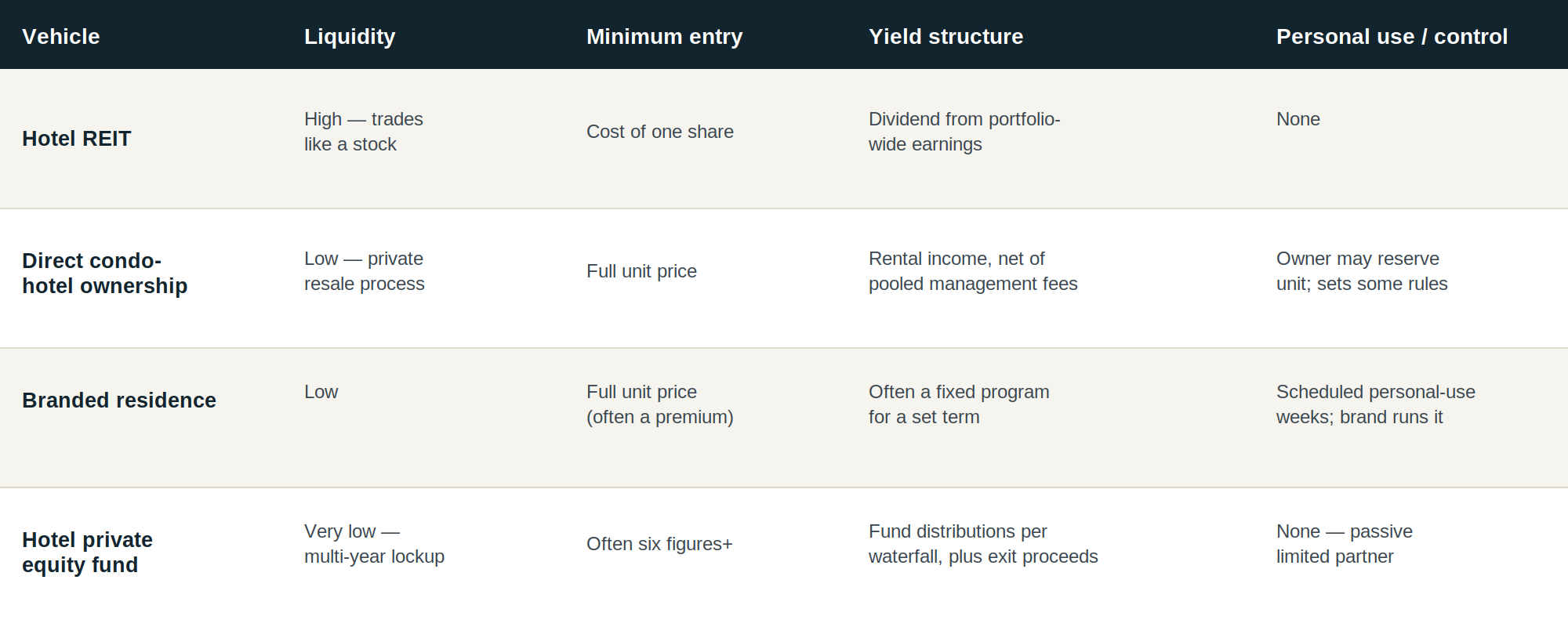
Before going deep on any one of them, here’s how a hotel REIT, direct condo-hotel ownership, a branded residence, and a hotel private equity fund actually compare on the things that matter most: how easily you can get your money back out, what it costs to get in, how the income is structured, and how much say you have.
Hotel REITs: liquid, diversified, hands-off
A hotel REIT owns and operates a portfolio of properties — sometimes dozens — and pays shareholders a dividend from the combined operating income. Buying in is as simple as buying any stock, and selling out is just as fast.
The trade-off is that you own a sliver of many hotels rather than a specific one, so there’s no personal-use benefit and no say in which properties the fund holds or how they’re run. Your return also moves with the broader market to some degree, not just with hotel performance specifically — REIT share prices react to interest rates and equity market sentiment, not only to how full the hotels are.
Best fit: investors who want hospitality exposure inside a normal brokerage account, with the ability to exit on a normal trading day.
Investing “in” Marriott or Hilton: what that actually means
This is worth spelling out because it’s genuinely confusing. When people say “I want to invest in Marriott” or “invest in Hilton,” they usually mean one of three very different things:
Buying the stock
You own a share of the parent company, which mostly collects franchise and management fees rather than owning hotels itself. This is a bet on the brand’s fee-generating business, not on any specific property.
Buying a franchise
You (or a company) own and finance the actual hotel and pay Marriott or Hilton for the right to use the brand and system. This requires far more capital and operating involvement than most retail investors want.
Buying a branded residence
You purchase a specific unit within a property that carries the brand under a licensing deal — this is what most people picturing “investing in a Marriott hotel room” actually mean, and it’s covered in more detail next.
Buying REIT shares that hold their hotels
Some hotel REITs’ portfolios happen to include Marriott- or Hilton-flagged properties. You’d own a diversified slice of those, not a specific branded room.
The brand name tells you almost nothing about which of these four you’re actually being offered — always confirm the structure before the name.
Branded residences: what the brand licence does and doesn’t guarantee
A branded residence is a specific, title-deeded unit that carries a hospitality brand’s name and design standards, usually operated as part of the hotel’s rental program when you’re not using it. The brand licence typically guarantees design and service standards, use of the brand name, and access to the hotel’s amenities and booking system — that’s real value, since it’s a large part of why the unit rents well and holds resale value.
What it usually does not guarantee is your yield. Guaranteed-yield programs are a separate contractual arrangement between you and the developer or operator, not a promise from the global brand itself. Two units carrying the identical brand name, in different developments, can have completely different — and completely separate — yield guarantees, terms, and counterparties standing behind them.
Best fit: investors who want a hard, deeded asset with personal-use rights and are comfortable underwriting the specific developer/operator, not just the brand on the door.
Hotel private equity funds: the institutional route
A hotel PE fund pools capital from multiple investors to acquire, reposition, or develop a portfolio of properties, targeting a return through operating income plus an eventual sale. Minimums are typically much higher than a single branded-residence unit, capital is usually locked up for several years, and you have no personal-use rights or say in individual property decisions — you’re a passive limited partner betting on the manager’s track record and deal pipeline.
Best fit: investors who want institutional-grade deal access and portfolio diversification, and can commit capital for the long haul without needing it back on a set schedule.
Which one actually fits you
Match your priority to the vehicle built around it:
I want to trade in and out easily
You’re prioritizing liquidity over everything else — you want to be able to sell on a normal market day if your view changes.
→ Hotel REIT
I want an asset I can actually stay in
You want scheduled personal-use weeks in a specific place, with income the rest of the year offsetting your ownership costs.
→ Branded residence
I want a specific unit, no brand premium
You want direct, title-deeded ownership and are comfortable with a non-branded management/rental program.
→ Direct condo-hotel
I want institutional deal access
You have patient capital, want professional management of a diversified portfolio, and don’t need personal use.
→ Hotel private equity fund
None of these is the “right” answer in the abstract — the right vehicle is simply the one built around what you’re actually optimizing for.